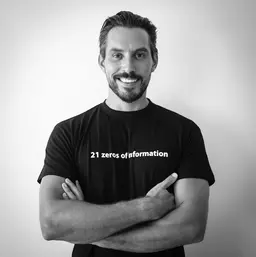
Eliot Knepper
co-founder
Former CMO who spent years drowning in global data silos. Leads the commercial and communications side. Believes a decision is only as good as the clarity behind it.
LinkedIn ↗about
dfmchn · Difference Machine started as a question from a science-fiction novel, picked up by two people who had spent years watching populations of customers behave in ways no dashboard could explain. Here is how it began, and who is building it.
the question
In Isaac Asimov's Foundation, a mathematician named Hari Seldon invents psychohistory: a science that predicts the movement of an entire civilization by treating people not as individuals but as one vast statistical population. It comes with two hard rules. It only works on large groups, and it can never tell you what a single person will do.
We are not Hari Seldon, and we are not predicting the future. But the question underneath the fiction stayed with us: can you model how a population, rather than a person, moves under pressure? On a far smaller and far more honest scale, that turned out to be answerable. That question is dfmchn.
Asimov's two rules aren't a disclaimer. They're the design. dfmchn reads the density of a whole population and the tipping points it moves through; it cannot, and does not try to, tell you what any one person will do. The name reaches back further still, to Charles Babbage's difference engine, the nineteenth-century machine built to compute by hand what no person could. A Difference Machine, pointed at human behavior.
the lineage
dfmchn comes from the team behind Mnemonic AI, the marketing-intelligence company Eliot Knepper and Phil Wennker founded in 2019. Eliot had been a CMO drowning in global customer data, with information from every market and no clear answer to the only question that mattered: who are these people, and what do they actually want? Phil was a machine-learning researcher who kept seeing the same gap from the other side, businesses generating behavioral data faster than anyone could make sense of it. Mnemonic was built to close that gap for marketers.
dfmchn is what happened when we pushed the same work past description and toward prediction. Understanding how a customer feels today is one thing. Modeling the moment a whole population tips is another, and once the math existed, it didn't care whether the population was customers, voters, patients, or employees. So we gave it its own name and let it stand on its own.
how we work
the founders
co-founder
Former CMO who spent years drowning in global data silos. Leads the commercial and communications side. Believes a decision is only as good as the clarity behind it.
LinkedIn ↗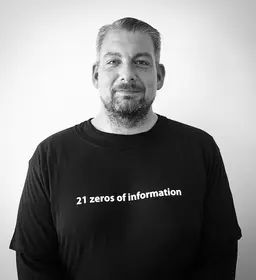
co-founder
Machine-learning researcher working at the frontier of applied AI. Builds the engine. Convinced the tools for understanding human behavior are still a decade behind the science, and set on closing the gap.
LinkedIn ↗bring us a population, or just ask us how it works.